The future of Virginia’s U.S. House representation hangs in the balance as the state’s Supreme Court considers whether to block a voter-approved congressional map that appears to favor Democrats. What makes this case extraordinary isn’t just the political implications—it’s the collision of democratic process, judicial authority, and constitutional interpretation. Voters ratified the map through a ballot initiative designed to ensure fair representation. Yet now, the very court tasked with upholding the law is being asked to overturn the people’s decision over claims of partisan imbalance.
This isn’t a case of politicians gerrymandering behind closed doors. This time, the people spoke—through a constitutional amendment—and the court may still override them. The tension underscores a growing national debate: when does judicial oversight become judicial overreach?
The Origins of Virginia’s Redistricting Reform
Virginia’s redistricting turmoil didn’t begin in a courtroom. It started with public frustration.
For decades, the state legislature drew congressional and legislative maps with little transparency. The results were predictable: lopsided districts that protected incumbents and diluted minority voting power. By the 2010s, court rulings had repeatedly struck down Virginia’s maps as racial gerrymanders, particularly in districts like the 3rd and 4th Congressional Districts, where Black voter influence was systematically minimized.
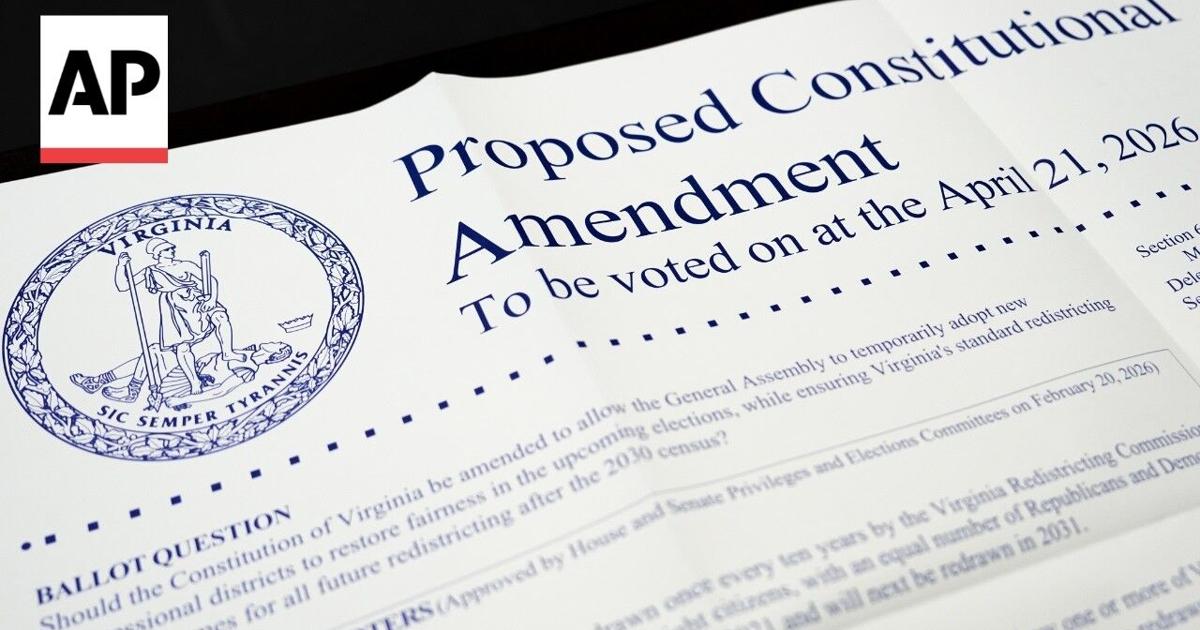
In response, reformers pushed for structural change. A coalition of advocacy groups, good government organizations, and bipartisan lawmakers championed a ballot measure: a constitutional amendment to create an independent redistricting commission. Voters approved it in 2020 with 66% support.
The amendment established a 16-member commission—eight lawmakers and eight citizens—charged with drawing fair, nonpartisan maps for both the House of Representatives and the state legislature. If the commission deadlocked, the task would fall to the Virginia Supreme Court.
Commission Deadlock and Court Intervention
The commission did deadlock.
Despite months of negotiation, Republicans and Democrats on the panel couldn’t agree on a congressional map. By law, the responsibility defaulted to the Virginia Supreme Court, which appointed a special master—retired judge John Charles Thomas—to draw the final map.
Thomas, a former justice on the Virginia Supreme Court himself, crafted a map that produced seven districts favoring Democrats and three favoring Republicans. Given that Virginia has leaned blue in presidential elections since 2008 and that statewide Democrats often win majorities in voter share, the outcome wasn’t surprising. But it was controversial.
Republican leaders and conservative groups cried foul, arguing that the map didn’t reflect the state’s full political diversity. They pointed to areas like Southwest Virginia, Roanoke, and parts of Northern Virginia’s exurbs where Republican support remains strong. They filed suit, claiming the map violated the state constitution’s requirement for “equal representation” and contended that Thomas’s plan packed Republican voters into a few districts while spreading Democratic strength across more.
What they’re really challenging is the legitimacy of the process itself.
Judicial Authority vs. Voter Mandate
At the heart of the case is a constitutional paradox.
The people voted to remove redistricting power from politicians and gave it to a commission—and ultimately, the courts, if needed. Now, the court is being asked to block the outcome of that very process.
Legal analysts are divided. Some argue that the Virginia Constitution’s redistricting provisions require political neutrality. Others note that the amendment doesn’t explicitly ban maps that favor one party—only those that dilute votes or violate federal civil rights laws.
“The people delegated authority to the court,” said Rebecca Green, co-director of the Campaign Legal Center’s redistricting program. “When the court exercises that authority, it can’t then claim the outcome is too partisan to uphold. That undermines the entire premise of the reform.”
Yet opponents counter that judicial neutrality means something more. Just because the court was given power doesn’t mean it can ignore constitutional standards. If the resulting map entrenches one-party dominance in violation of equal representation principles, they argue, the court has a duty to intervene.
What ‘Favoring Democrats’ Actually Means
Labeling the map as “favoring Democrats” oversimplifies a complex political reality.
Virginia isn’t a deep-blue state. It’s a purple one that has elected Republican governors as recently as 2021. But presidential and Senate voting patterns show a consistent Democratic edge in statewide races. In 2020, Joe Biden won Virginia by nearly 10 points. Democrats also won both Senate seats and dominate statewide offices.
Under these conditions, a 7–3 Democratic advantage in congressional representation isn’t necessarily out of line. The national benchmark for “fairness” in redistricting often accounts for a state’s partisan lean, not just raw registration numbers.
Consider this comparison:
| Metric | Virginia (2020–2022) | National Median |
|---|---|---|
| Avg. Democratic Presidential Vote | 54.3% | 51.6% |
| Avg. Democratic Senate Vote | 53.8% | 50.9% |
| Projected House Seat Advantage | D+2 | D+1 |
| Actual New Map Outcome | 7D–3R | — |
The map aligns closely with Virginia’s political behavior. In contrast, many states with similar partisan profiles have more lopsided delegations due to aggressive gerrymandering. North Carolina, for instance, has a nearly identical partisan split but a 7–6 Republican edge in House seats—a discrepancy federal courts have previously questioned.
The real issue isn’t bias alone. It’s whether the process respected both procedural rules and substantive fairness.
Practical Implications for 2024 and Beyond
If the Virginia Supreme Court blocks the current map, the consequences will ripple far beyond legal theory.
Congressional candidates are already preparing for the 2024 election cycle. Filing deadlines loom. Campaigns have launched. Changing the map now would force redrawing district boundaries, requalifying candidates, and confusing voters.
“It creates chaos,” said Nathan Gonzales, editor of Inside Elections. “Campaigns base fundraising, field operations, and messaging on district demographics. Upending that months before an election undermines electoral stability.”
Moreover, delaying or invalidating the map could set a dangerous precedent. Future commissions might deadlock, knowing the courts could later reject their work based on partisan outcomes rather than process violations.
On the other hand, allowing the map to stand—even if it advantages Democrats—reinforces the credibility of the reform. It signals that the people’s choice, carried out through a neutral third party, will be respected—even when the outcome doesn’t please all sides.
Precedent and National Context
Virginia’s case arrives amid a national reckoning over redistricting.
In states like Ohio and North Carolina, courts have struck down maps for excessive partisan gerrymandering. But those were cases where the legislature—controlled by one party—drew maps to entrench power. Virginia’s situation is different: the legislature didn’t draw the map. The people’s process did.
The U.S. Supreme Court, in Rucho v. Common Cause (2019), ruled that federal courts can’t police partisan gerrymandering, calling it a “political question.” But state courts can interpret their own constitutions more broadly. Pennsylvania’s Supreme Court, for example, blocked a Republican-drawn map in 2018, citing the state constitution’s free and equal elections clause.
Virginia’s court now faces a similar test. Will it act as a neutral arbiter of process—or as a political referee?
Legal experts warn against overreach. “When courts start invalidating maps because one party benefits, even under a fair process, it risks politicizing the judiciary,” said Richard L. Hasen, election law professor at UCLA. “The better path is to fix the process, not the outcome.”
What a Ruling Could Look Like
Two possible rulings loom.
Option A: The court upholds the map, citing the constitutional amendment’s delegation of authority and the special master’s nonpartisan credentials. It may emphasize that the map complies with federal voting rights law, avoids racial gerrymandering, and reflects statewide voting patterns.
Option B: The court blocks the map, arguing that the resulting partisan skew violates the state constitution’s equal representation guarantees. It could order a new map drawn by a different special master—or even reopen the commission process.
Option A strengthens institutional trust. Option B reopens political warfare.
There’s also a middle ground: the court could remand the case with specific criteria—compactness, contiguity, community preservation—and allow Thomas or another expert to revise the map within defined limits. This would respect both process and principle.
A Test of Democratic Maturity
This moment isn’t just about maps or seats. It’s about whether Virginia can model a better way.
For years, redistricting was a backroom game. Now, citizens have a voice. The irony is that when the process works—when it removes politicians from the equation—some still seek to reject outcomes they dislike.
The best defense of democracy isn’t getting your preferred result. It’s accepting the rules, even when they don’t favor you.
Virginia’s Supreme Court has a rare opportunity: to affirm that reform matters, that process counts, and that the people’s will—channeled through a fair, independent method—deserves finality.
Blocking the map would signal that only symmetric outcomes are acceptable, regardless of voter behavior. Upholding it would say that evolving political landscapes are part of democracy—not a bug to be fixed by courts.
The Path Forward Is Clear
The Virginia Supreme Court should uphold the voter-approved congressional map.
It was crafted under a constitutionally mandated process, respects federal law, and reflects the state’s actual voting patterns. Overturning it would undermine the very reform voters demanded.
Lawmakers should focus on strengthening the commission model for future cycles—perhaps by requiring supermajority votes or adding transparency measures. Courts should police process, not political outcomes.
And citizens should remember: fairness isn’t symmetry. It’s a system that listens, follows rules, and delivers accountable representation—even when it doesn’t guarantee your side wins.
FAQ
Why is the Virginia Supreme Court involved in drawing maps? Because the voter-approved redistricting commission deadlocked, the state constitution assigned the task to the Supreme Court, which delegated it to a special master.
Does the map violate the U.S. Constitution? No federal court has ruled it does. It complies with the Voting Rights Act and doesn’t engage in racial gerrymandering.
Can the court block a voter-approved process? Legally, yes—if it finds a constitutional violation. But doing so risks undermining public trust in reform efforts.
How does this map compare to previous Virginia maps? Earlier maps were struck down for racial bias. This one was drawn by a neutral judge and is considered more transparent and legally defensible.
What happens if the court blocks the map? It could delay elections, force candidate redistricting, and prompt new litigation—creating chaos months before the 2024 vote.
Who benefits from the current map? Seven districts lean Democratic, three lean Republican. This aligns with Virginia’s recent statewide voting trends.
Could this set a national precedent? Yes. Other states watching redistricting reform may look to Virginia as a model—or a cautionary tale—depending on the outcome.
FAQ
What should you look for in Virginia Supreme Court Weighs Fate of Democratic-Favoring House Map? Focus on relevance, practical value, and how well the solution matches real user intent.
Is Virginia Supreme Court Weighs Fate of Democratic-Favoring House Map suitable for beginners? That depends on the workflow, but a clear step-by-step approach usually makes it easier to start.
How do you compare options around Virginia Supreme Court Weighs Fate of Democratic-Favoring House Map? Compare features, trust signals, limitations, pricing, and ease of implementation.
What mistakes should you avoid? Avoid generic choices, weak validation, and decisions based only on marketing claims.
What is the next best step? Shortlist the most relevant options, validate them quickly, and refine from real-world results.

:max_bytes(150000):strip_icc():focal(728x145:730x147)/malcolm-in-the-middle-reboot-justin-berfield-erik-per-sullivan-frankie-munz-bryan-cranston-032625-ba641070781e4402978a76b2ed030e7c.jpg)